

Window Academy
Learn how replacement windows actually work, so you can buy with confidence.
We're going to teach you how windows actually work, so you can decide for yourself.
Jump straight into a section, or start below
Start Here — The Anatomy of a Replacement Window
Buying replacement windows can feel overwhelming.
Every company claims to have the best product, the best warranty, and the best installation. Most presentations focus on telling you why you should buy from them. Very few take the time to explain how replacement windows actually work or why one window performs differently from another.
That's why we created Window Academy.
Our philosophy is simple:
An educated homeowner makes a better decision than a pressured homeowner.
Instead of telling you what to buy, we're going to teach you how replacement windows actually work.
Along the way, we'll explore the engineering, materials, manufacturing, installation, and real-world performance that make one window different from another. Some lessons are perfect for homeowners just getting started. Others dive deeper for the curious minds who want to understand the details.
By the time you finish this guide, you'll understand the major components of a modern replacement window, what each one does, and why every piece matters.
This is the foundation for everything you'll learn throughout Window Academy.
Think of a Replacement Window Like a Car

Nobody would describe a car as simply an engine with four wheels.
A car is a complete system. The engine produces power, the suspension absorbs impacts, the brakes provide control, and the transmission transfers that power to the road. Every component has a specific job, and the vehicle only performs well when those parts work together.
A replacement window is no different.
Although it may look like a simple frame with glass, it's actually a carefully engineered system made up of dozens of components designed to manage heat, sunlight, air, water, structural loads, sound, and everyday operation.
Just like removing one important part from a car affects how it drives, changing one component in a window can dramatically impact its energy efficiency, durability, comfort, and lifespan.
That's why understanding how the entire system works together is far more valuable than memorizing brand names or marketing claims.
🔬 Engineering Insight
A modern replacement window isn't designed around a single feature—it's engineered as a complete system. The frame, sash, glass, spacer, weatherstripping, hardware, drainage, and installation all influence one another. Improving one component while neglecting another often limits the overall performance of the window.
01 — Overview
Let's Take the Window Apart
The Anatomy of a Replacement Window
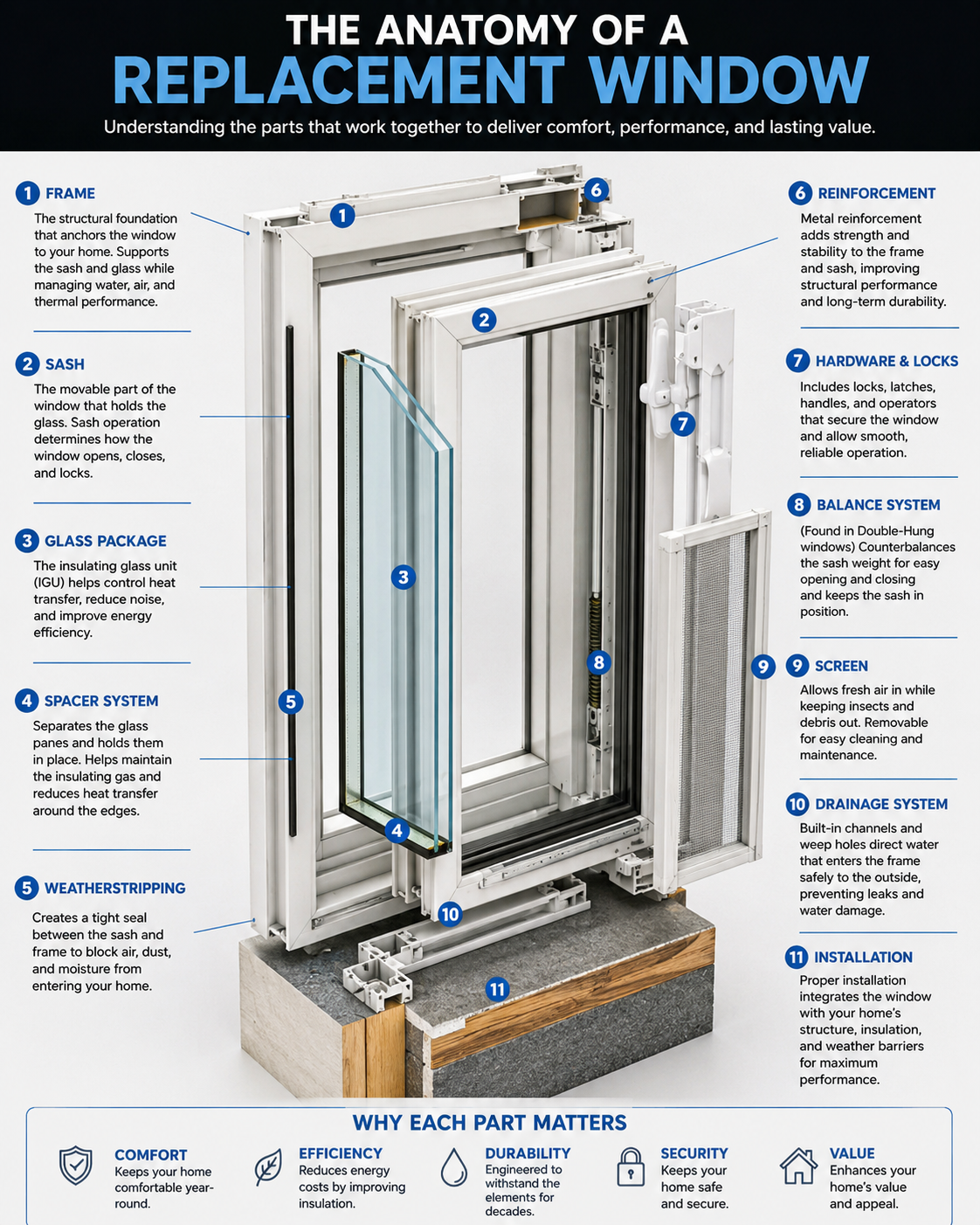
Every replacement window is made up of dozens of individual components, but nearly all modern windows share the same major building blocks. Each component has a specific purpose, and together they determine how the window performs over decades of use.
By the end of this guide, you'll never look at a replacement window the same way again.
Below are the major components you'll find in modern replacement windows and why each one matters.
Meet the Parts — every modern replacement window is built from these major systems
- Frame — Supports the entire window system
- Sash — Holds the glass and operates the window
- Glass Package — Controls heat, light, and energy efficiency
- Spacer System — Separates glass panes and retains insulating gas
- Weatherstripping — Helps seal against air, dust, and water
- Reinforcement — Increases structural strength and rigidity
- Hardware — Allows the window to lock and operate smoothly
- Screens — Provides ventilation while keeping insects out
- Drainage System — Safely manages water that enters the frame
- Installation — Integrates the window into your home's structure
02 — Component
The Frame
The structural foundation of the entire window
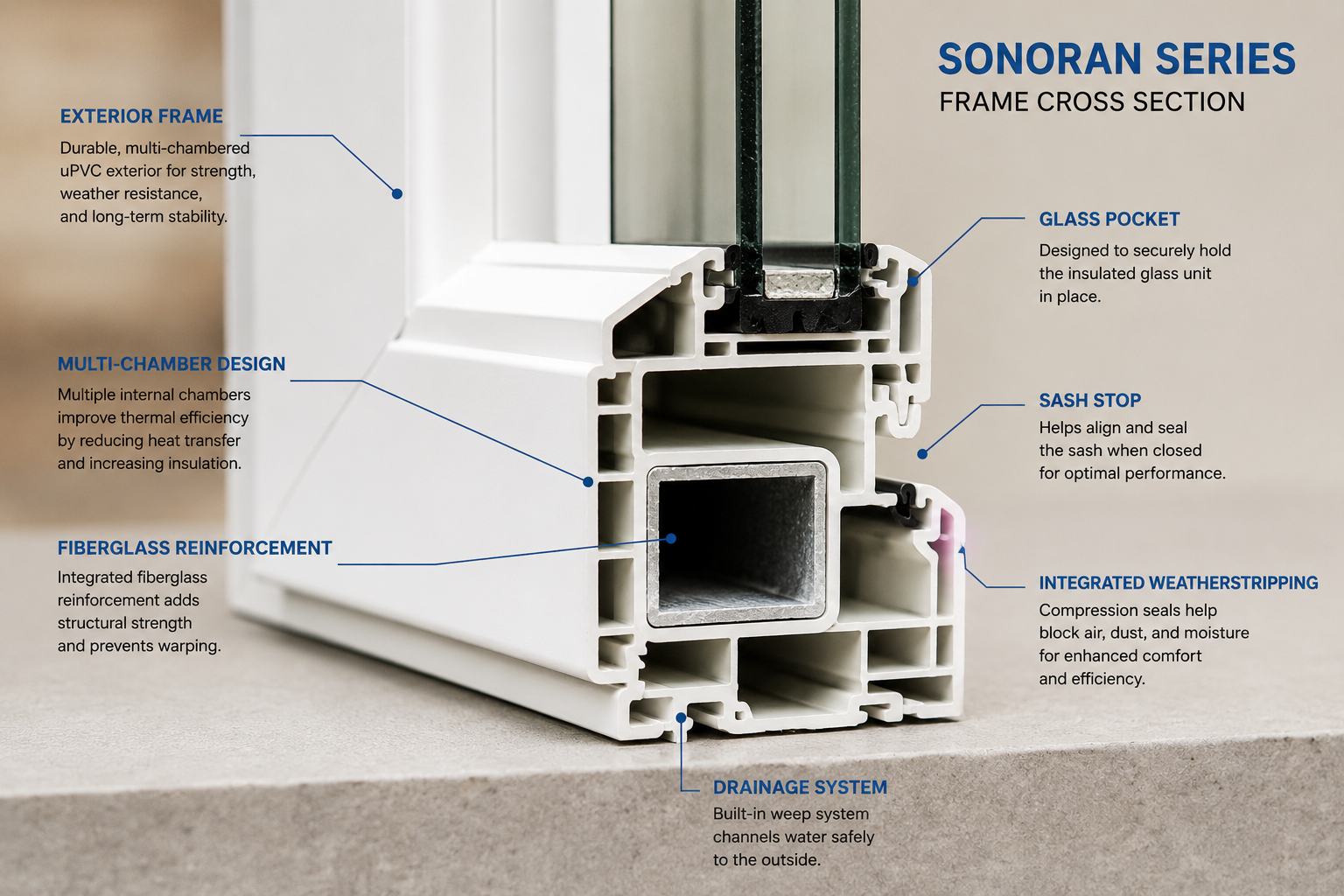
The frame is the structural foundation of the entire replacement window.
It permanently attaches to your home's opening while supporting nearly every other component of the window system.
Think of it as the skeleton of the window.
Without a properly engineered frame, even the best glass package or hardware cannot perform as intended.
A well-designed frame is responsible for:
- Supporting structural loads
- Maintaining long-term dimensional stability
- Providing attachment points for hardware
- Managing water through internal drainage paths
- Reducing heat transfer
- Supporting weather seals
- Holding the sash square throughout years of operation
Although frames may appear similar from the outside, what's happening inside the frame often tells a very different story.
Internal chambers, wall thickness, reinforcement, drainage paths, and material composition all play a role in how a window performs over its lifetime.
🔬 Engineering Insight
A replacement window frame isn't simply designed to hold glass.
It must balance structural strength, thermal performance, manufacturability, drainage, hardware support, and long-term durability—all while remaining dimensionally stable through thousands of heating and cooling cycles.
This is why two vinyl windows that appear almost identical from the outside can perform very differently after years of exposure to Arizona's climate.
🌵 Arizona Insight
Arizona places extraordinary demands on a window frame.
Daily thermal expansion, intense UV exposure, dust storms, and summer temperatures exceeding 110°F all work against the materials over time.
That's why frame engineering matters just as much as the glass itself.
03 — Component
The Sash
The part of the window that does the work
If the frame is the foundation of a replacement window, the sash is the part that does the work.
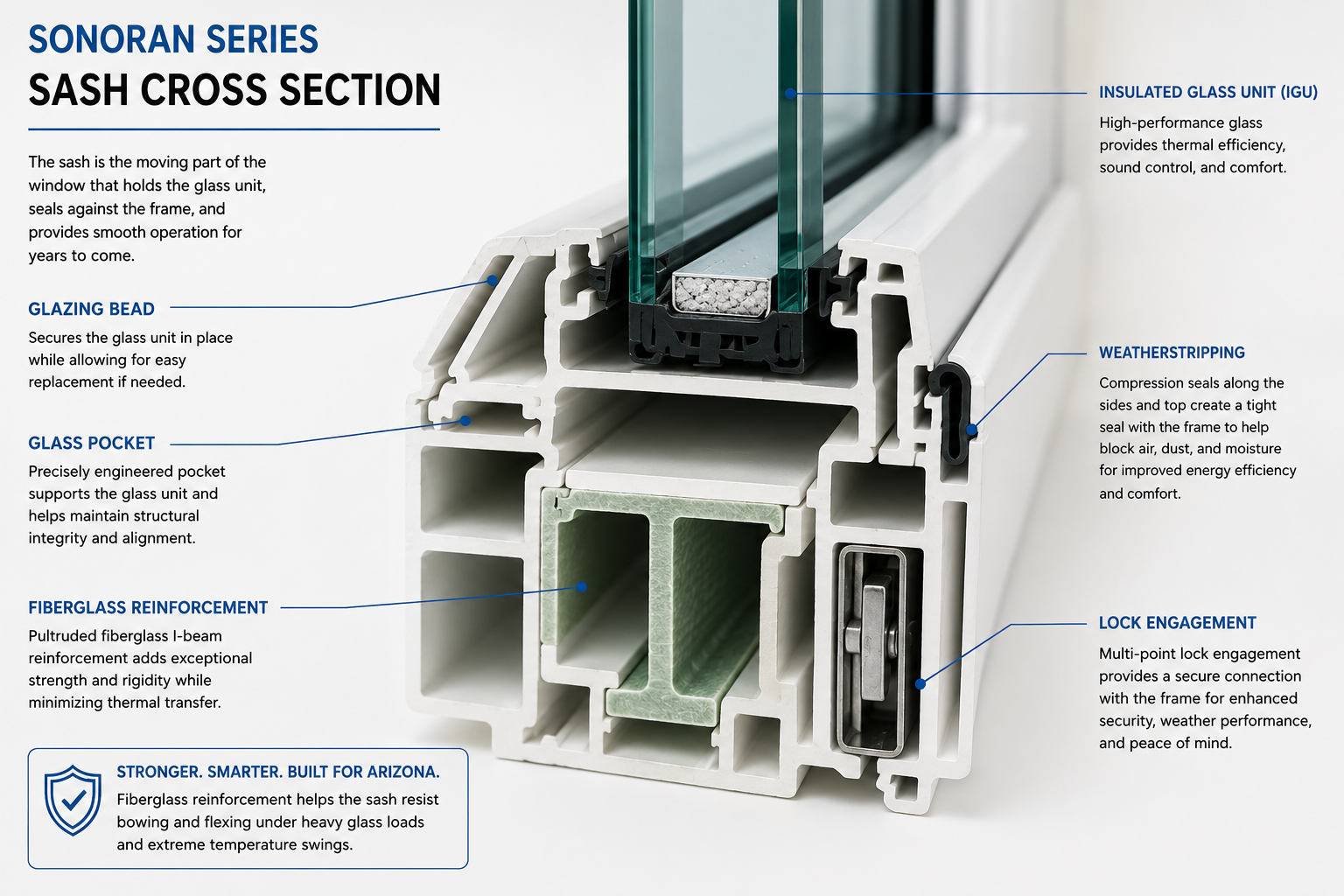
The sash is the portion of the window that holds the insulated glass unit and, on operable windows, slides, swings, or opens to provide ventilation. Every time you unlock, open, or close your window, you're operating the sash—not the frame.
Although it may look simple from the outside, the sash is one of the most engineered components of the entire window system.
It must be rigid enough to support heavy insulated glass, maintain an airtight seal against the frame, resist years of expansion and contraction, and continue operating smoothly through thousands of open-and-close cycles.
When a sash is well engineered, you rarely think about it.
When it isn't, problems begin to appear.
Why the Sash Matters
A properly designed sash helps determine:
- Structural strength
- Energy efficiency
- Air infiltration
- Dust resistance
- Water resistance
- Ease of operation
- Long-term durability
- Glass support
- Lock alignment
Even small amounts of flex can affect how well a window seals over time.
🔬 Engineering Insight
The sash carries most of the weight of the insulated glass unit.
Modern double-pane glass can weigh 2.5 to 3 pounds per square foot, while triple-pane glass can exceed 4 pounds per square foot depending on thickness and laminated components.
Over time, that weight constantly pulls on the sash.
That's why premium window systems often use thicker extrusions, internal reinforcement, and carefully engineered corner welds to help the sash remain square for years of operation.
🌵 Arizona Insight
Arizona puts enormous stress on a window sash.
Every day, the sash expands as temperatures climb and contracts as they cool overnight. Add intense UV exposure, dust storms, and years of operation, and even small differences in sash design can have a noticeable impact on long-term performance.
A stronger sash helps maintain tighter weather seals, smoother operation, and better alignment throughout the life of the window.
Sonoran Series Spotlight
One feature that separates the Sonoran Series from many conventional vinyl windows is its fiberglass-reinforced sash design.
Instead of relying solely on thicker vinyl walls or metal reinforcement, the Sonoran Series uses pultruded fiberglass I-beam reinforcement integrated into the sash. Fiberglass is exceptionally rigid while remaining a poor conductor of heat, allowing the sash to increase structural strength without introducing the thermal bridging associated with many metal reinforcements.
This reinforced design helps the sash better support larger insulated glass units, maintain its shape under load, and preserve tight weather seals over years of operation.
❌ Common Myth
"A thicker frame automatically means a stronger window."
Not necessarily.
The strength of a replacement window depends on the entire structural system—including the sash, internal reinforcement, corner welds, material composition, and overall engineering—not simply how thick the outside profile appears.
🎓 Key Takeaways
- ✔️ The sash is the part of the window that actually operates.
- ✔️ It supports the full weight of the insulated glass.
- ✔️ A stronger sash helps maintain air seals, smooth operation, and structural integrity.
- ✔️ Reinforcement and engineering matter far more than appearance alone.
04 — Component
The Insulated Glass Unit (IGU)
The heart of every energy-efficient replacement window
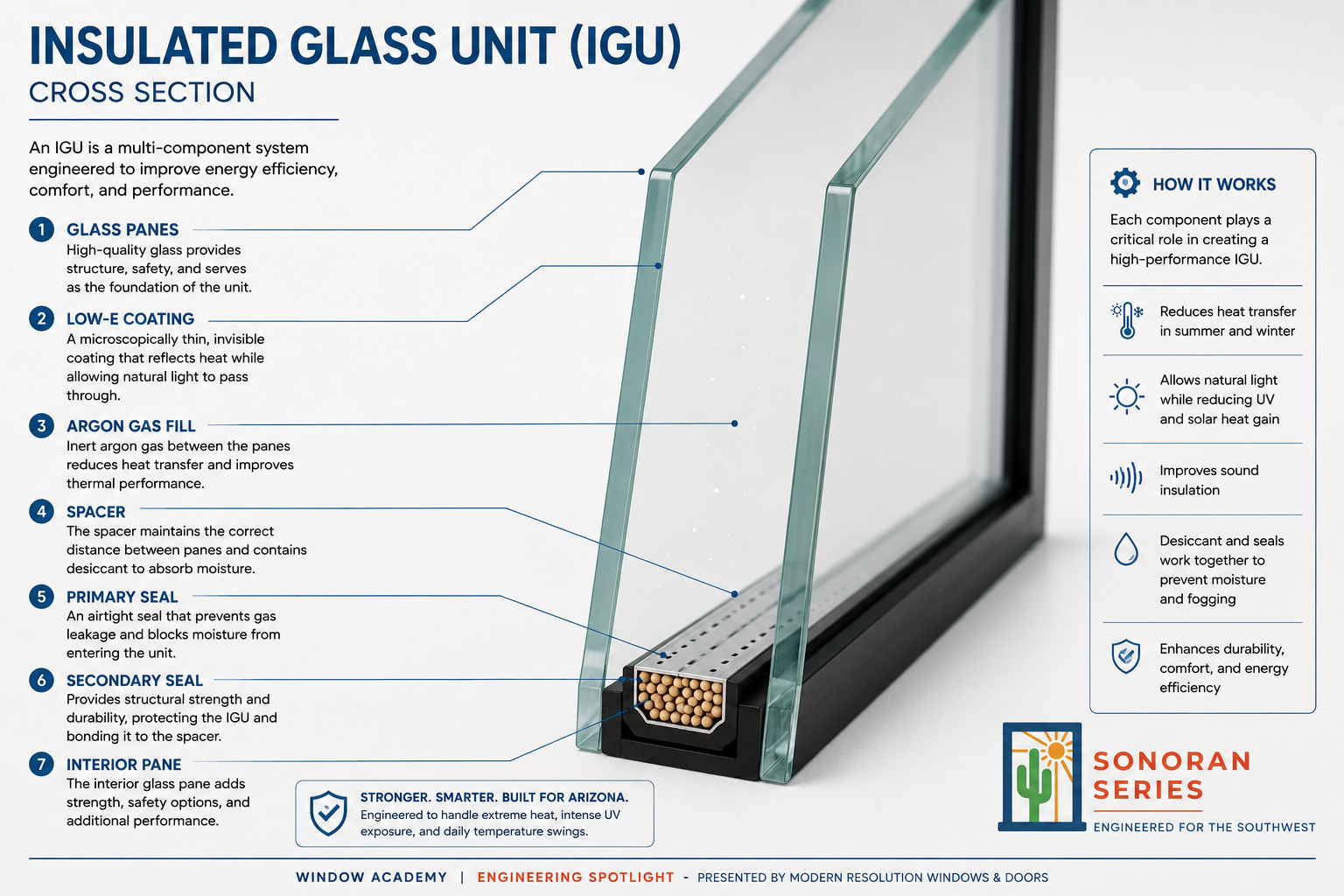
If the frame is the skeleton and the sash is the muscle, the insulated glass unit—or IGU—is the heart of the window.
Most homeowners think a replacement window is simply "double-pane glass."
In reality, an insulated glass unit is a precision-engineered assembly designed to control heat transfer, reduce noise, improve comfort, and increase energy efficiency.
Although it appears simple, an IGU is made up of multiple components working together as a single system.
Understanding how these components interact is one of the biggest steps toward understanding modern replacement windows.
05 — Component
Low-E Glass
The invisible technology that changed modern windows forever
Have you ever stood next to a sunny window and felt the heat on your face, even though the window was closed?
That warmth isn't coming through because your window is open.
It's coming through because sunlight carries energy in multiple forms, and ordinary glass allows much of that energy to pass into your home.
Low-E glass changed that.
Today, nearly every high-performance replacement window relies on an incredibly thin, virtually invisible metallic coating that selectively reflects heat while still allowing natural light to pass through.
It's one of the biggest advancements in residential window technology over the past several decades.
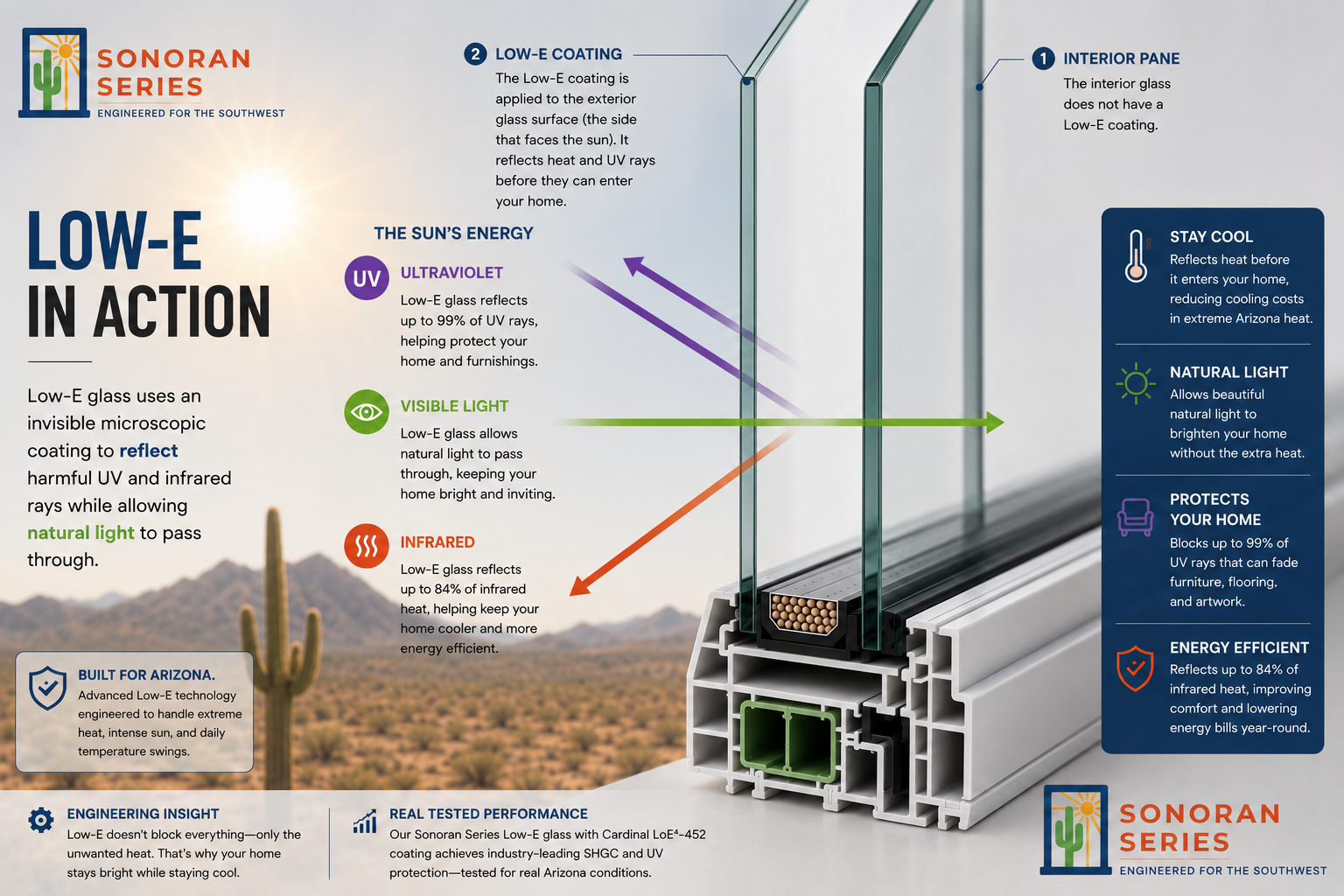
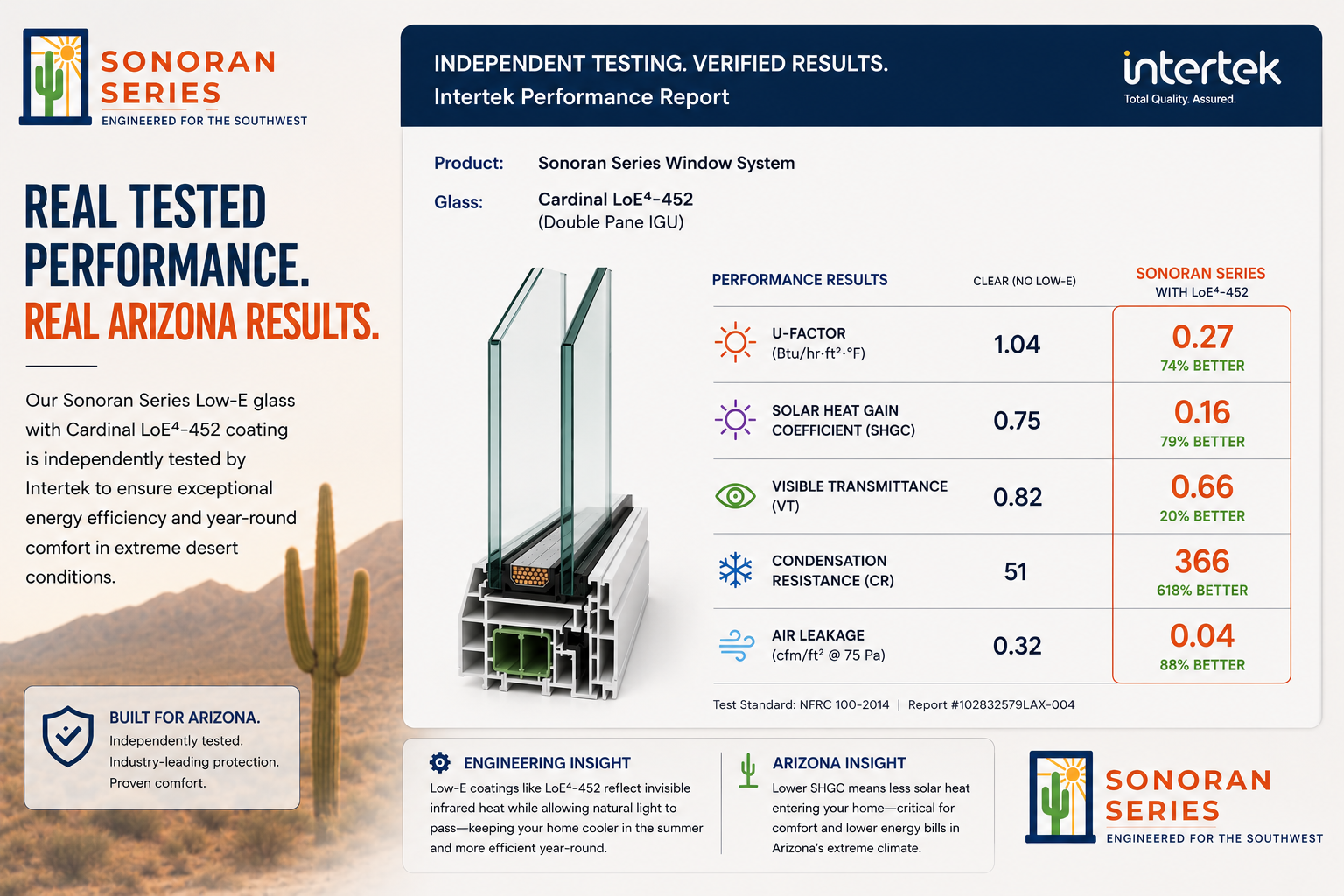
Choosing the right glass package isn't about finding the "best" number. It's about finding the right balance between solar heat control, natural daylight, and the way you live.
To better understand how different Low-E coatings perform, the Sonoran Series picture window was evaluated using NFRC simulation procedures with multiple Cardinal glass packages, including LoĒ³-366 and LoĒ⁴-452 configurations.
Both are excellent Low-E coatings, but they were engineered with different priorities.
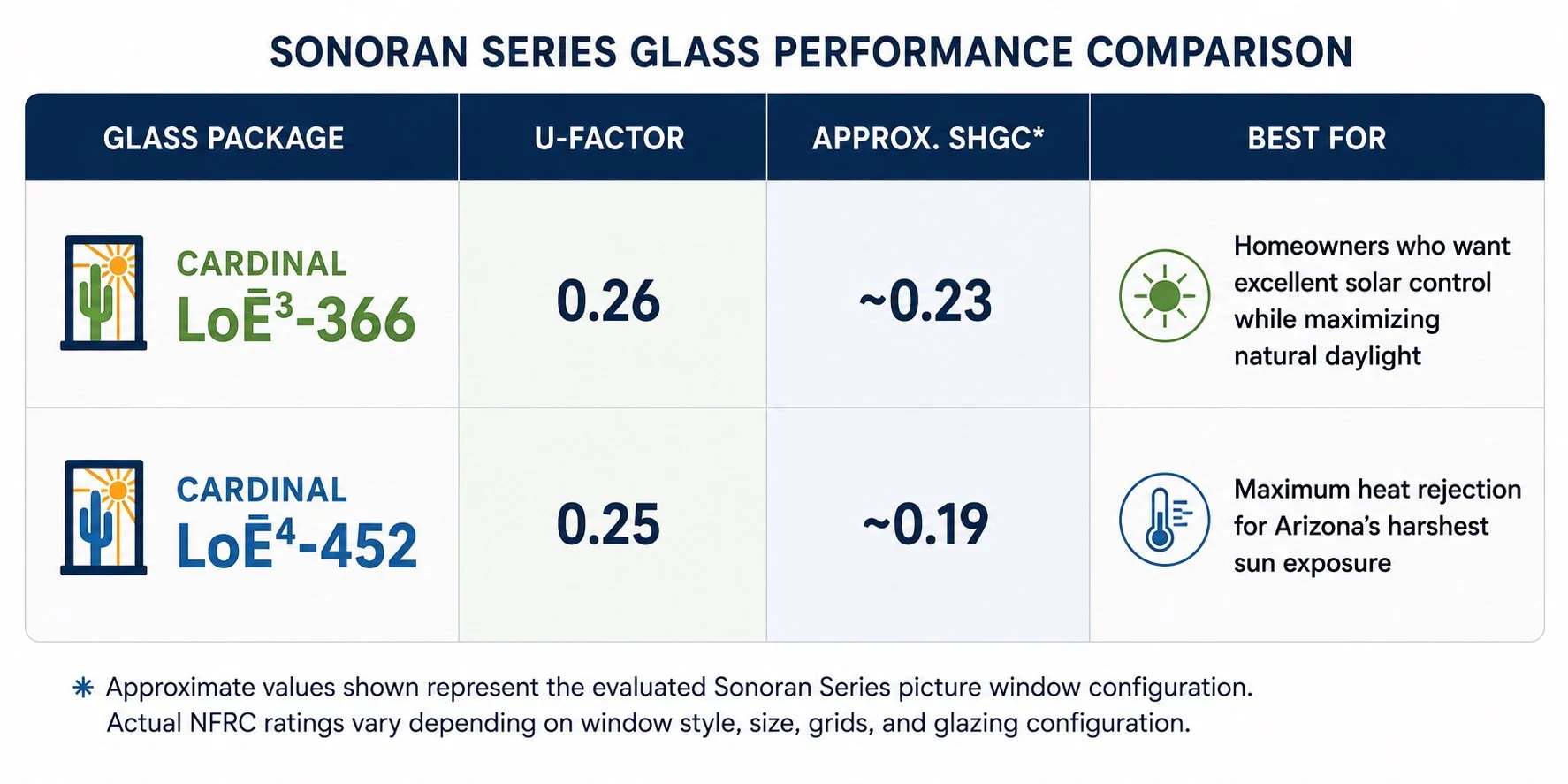
Two Great Choices
One of the biggest misconceptions in the window industry is that there is only one "best" glass package.
In reality, Cardinal LoĒ³-366 and LoĒ⁴-452 are both premium Low-E coatings, each designed to solve a slightly different problem.
Neither is objectively better. They simply prioritize different performance characteristics.
Cardinal LoĒ³-366 — Excellent Solar Control with More Natural Light
For many Arizona homeowners, LoĒ³-366 offers an outstanding balance between energy efficiency and brightness.
It reflects a significant amount of unwanted solar heat while still allowing more natural daylight into the home than more aggressive solar-control coatings.
Many homeowners prefer LoĒ³-366 because rooms feel bright and open without sacrificing excellent energy performance.
Best suited for:
- Living rooms
- Kitchens
- North-facing windows
- Homes with mature landscaping
- Homeowners who value abundant natural daylight
Cardinal LoĒ⁴-452 — Maximum Solar Heat Rejection
LoĒ⁴-452 was developed specifically for climates where cooling performance is the highest priority.
Its additional solar-control layer reflects more infrared energy before it enters the home, reducing heat gain during Arizona's hottest afternoons.
The tradeoff is simple: you gain additional heat rejection while allowing slightly less visible light through the glass.
For homeowners battling intense western exposure or large walls of glass, this can be a worthwhile compromise.
Best suited for:
- West-facing windows
- South-facing glass
- Large picture windows
- Homes with minimal shade
- Homeowners prioritizing maximum cooling performance
The Tradeoff
This is where understanding SHGC becomes valuable.
Lower SHGC generally means less solar heat entering your home.
However, lower SHGC can also reduce the amount of visible daylight transmitted through the glass.
That doesn't mean one glass package is better than the other. It means each was engineered for different priorities.
Think of it like choosing sunglasses. Some people want maximum sun protection. Others want a brighter view while still reducing glare. Both are excellent choices.
🔬 Engineering Insight
SHGC is a whole-window performance rating, not simply a measurement of the glass itself.
The final SHGC depends on the complete window system, including:
- Low-E coating
- Glass package
- Spacer system
- Gas fill
- Frame design
- Window size
- Grid configuration
- Overall window construction
This is why two windows using the same Low-E coating may still receive different NFRC ratings.
❌ Common Myth
"All Low-E glass is basically the same."
Not even close.
Different Low-E coatings are engineered for different climates and performance goals.
Simply seeing "Low-E" on a brochure doesn't tell you how much solar heat the window blocks or how much daylight it allows into your home.
Always ask for the actual performance ratings.
❌ Another Common Myth
"The lowest SHGC is always the best."
Not necessarily.
A west-facing family room may benefit from the additional solar control of LoĒ⁴-452. A shaded living room or kitchen may benefit from the brighter appearance of LoĒ³-366.
The best glass package depends on:
- Window orientation
- Exterior shading
- Room usage
- Personal preference
- Desired amount of natural light
Great window design is about choosing the right solution—not chasing the lowest number.
🌵 Arizona Insight
Arizona presents one of the most demanding environments for residential windows.
With intense sunshine throughout much of the year, reducing solar heat gain often has a greater impact on comfort than homeowners realize.
That's why SHGC is one of the first specifications we recommend comparing when evaluating replacement windows in Arizona.
At the same time, natural light matters too. For many homeowners, the ideal window isn't simply the one with the lowest SHGC—it's the one that delivers the right combination of comfort, daylight, and energy efficiency for each room.
💡 Pro Tip
If you're replacing every window in your home, don't assume every opening needs the exact same glass package.
Many high-performance homes use different glazing strategies depending on window orientation, balancing daylight, comfort, and energy efficiency throughout the house.
🎓 Key Takeaways
- ✅ SHGC measures how much of the sun's heat enters through the complete window system.
- ✅ Cardinal LoĒ³-366 and LoĒ⁴-452 are both premium Low-E coatings engineered for different priorities.
- ✅ LoĒ³-366 offers an excellent balance of solar control and natural daylight.
- ✅ LoĒ⁴-452 provides even greater solar heat rejection for Arizona's most demanding exposures.
- ✅ The best-performing window isn't simply the one with the lowest SHGC—it's the one that best matches your home's orientation, your comfort goals, and the Arizona climate.
06 — Performance Rating
Solar Heat Gain Coefficient (SHGC)
The number that matters most when Arizona sunlight is trying to cook your house
Have you ever stood beside a sunny window and felt heat radiating into the room, even though the window was closed?
That heat is solar energy passing through the glass.
Solar Heat Gain Coefficient, usually shortened to SHGC, measures how much of that solar heat enters your home through the complete window system.
SHGC is expressed as a number between 0 and 1.
- A window with an SHGC of 0.70 allows a large amount of solar heat to pass through.
- A window with an SHGC of 0.30 allows much less.
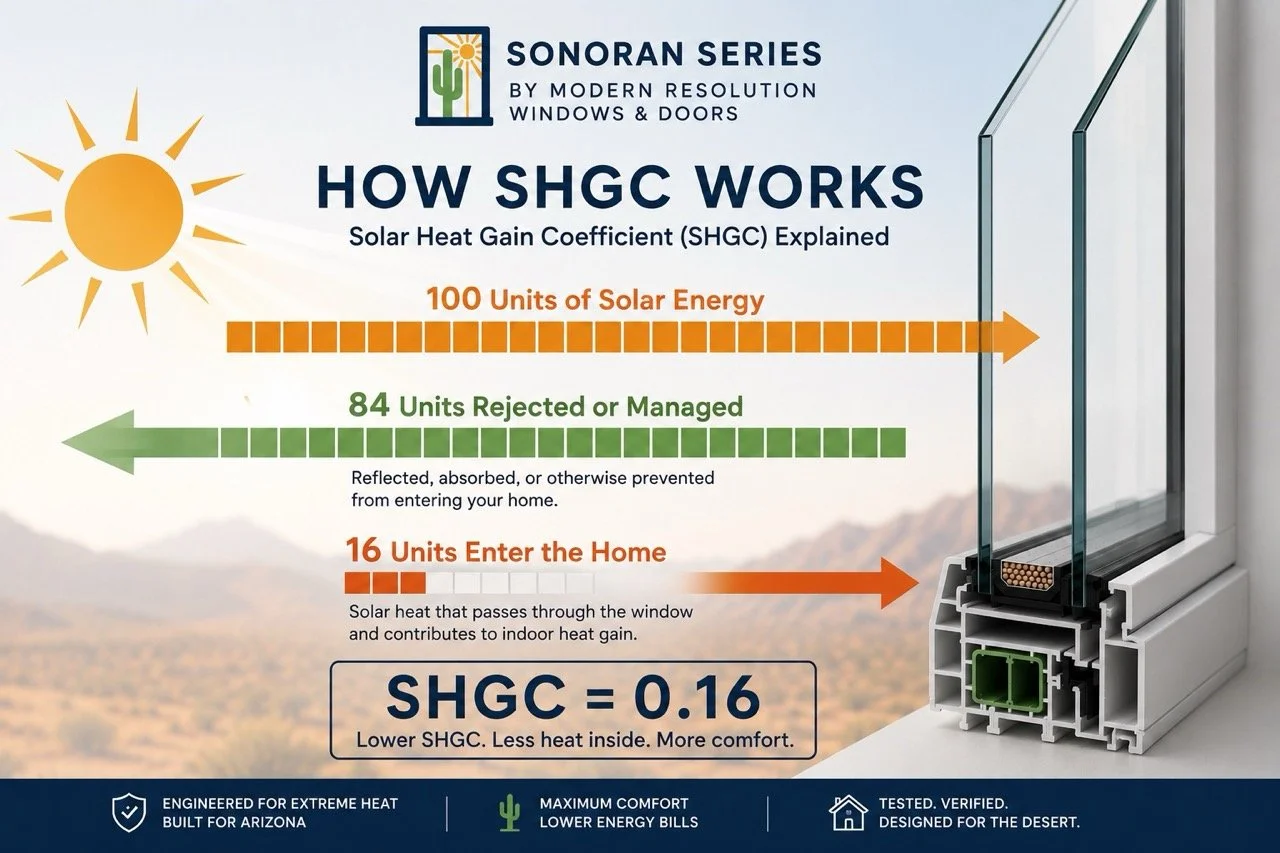
- A window with an SHGC of 0.16 allows approximately 16% of the measured solar energy through under standardized rating conditions.
For hot, sunny climates like Arizona, lower SHGC generally means better protection against unwanted solar heat gain.
Understanding SHGC in Plain English
Think of sunlight as 100 units of solar energy striking the window.
If the complete window has an SHGC of 0.16, approximately 16 of those units contribute to heat gain inside the home under the standardized test conditions used for the rating.
The remaining solar energy is reflected outward, absorbed by the glazing system, or otherwise prevented from passing directly into the conditioned space.
That is why SHGC can dramatically affect:
- Indoor comfort
- Cooling demand
- Hot rooms near west-facing windows
- Air-conditioning runtime
- Solar heat buildup throughout the afternoon
Lower Is Not Always Better Everywhere
SHGC is climate-dependent.
In colder climates, homeowners may sometimes benefit from allowing more winter sunlight into the home. In Arizona, the challenge is almost always the opposite.
Our homes already receive intense solar exposure for much of the year. Allowing unnecessary solar heat through the windows increases the amount of work the cooling system must perform.
That makes SHGC one of the most important performance ratings for replacement windows in Phoenix, Scottsdale, Mesa, Chandler, Gilbert, Prescott, and other Arizona communities.
07 — Performance Rating
U-Factor
Why SHGC and U-Factor measure completely different things
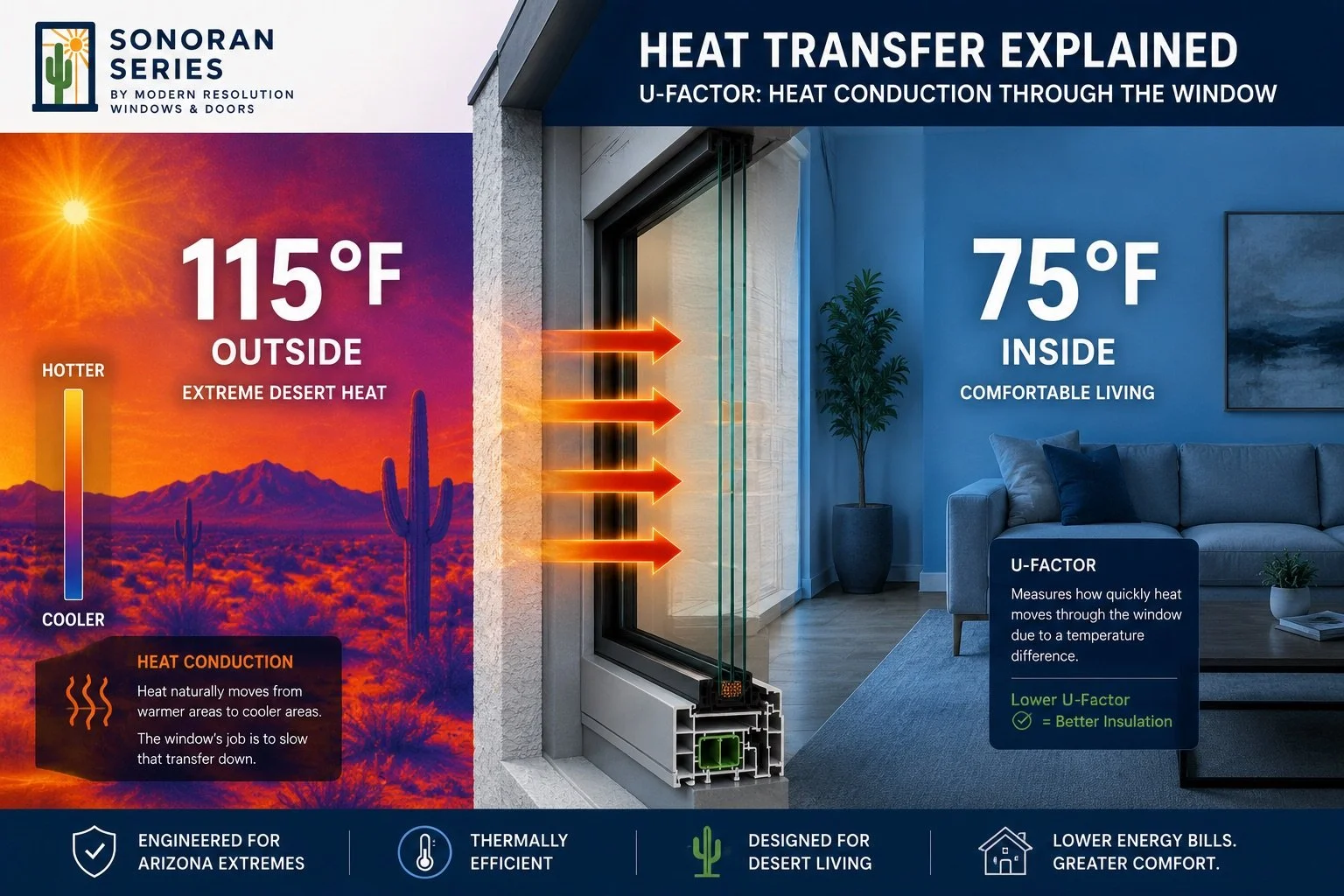
Everyone hears about U-Factor.
Very few people understand what it actually measures.
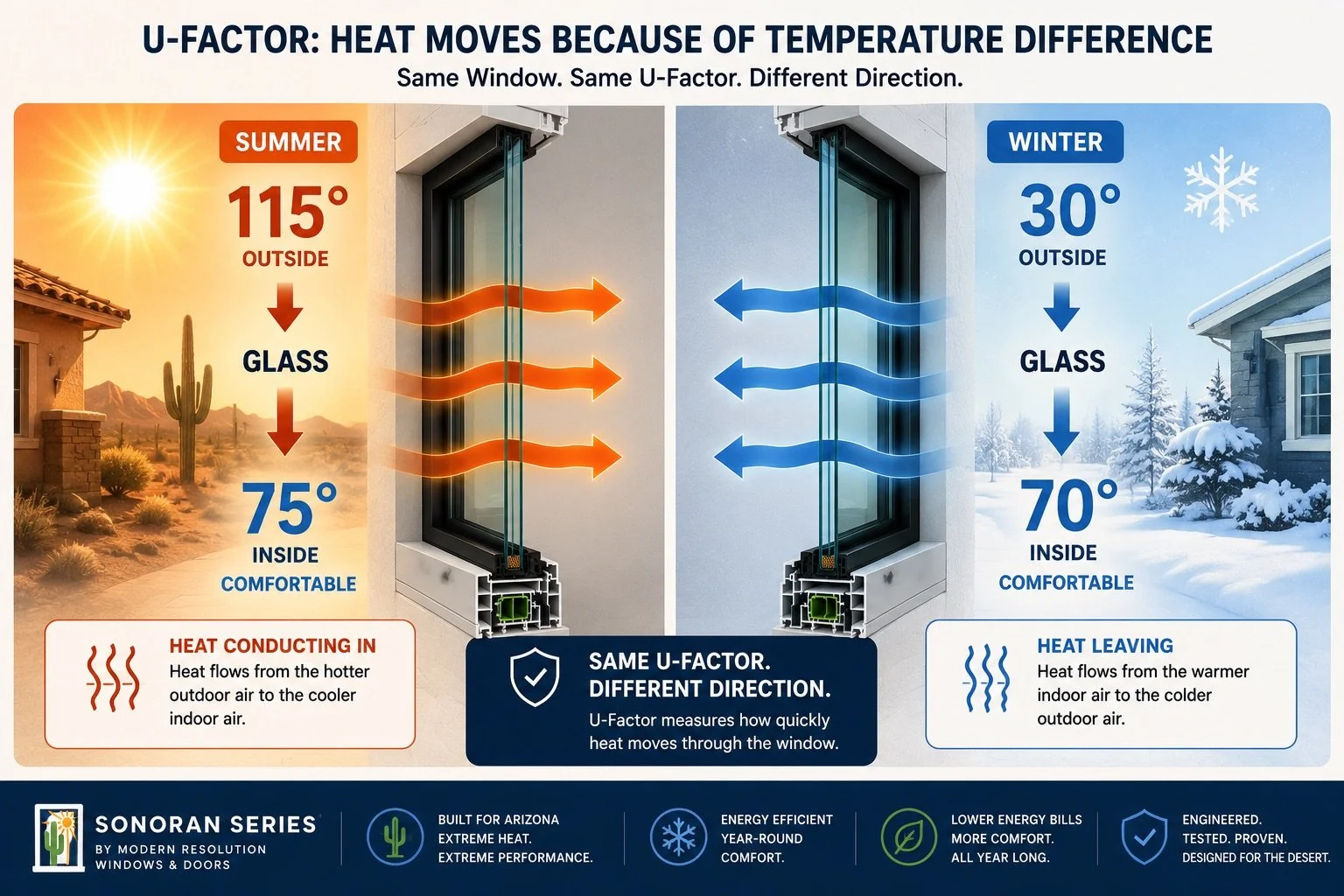
Unlike SHGC, which measures solar energy from the sun, U-Factor measures how quickly heat moves through the complete window because of a temperature difference between indoors and outdoors.
Think of SHGC as sunlight. Think of U-Factor as heat conduction. They're measuring two completely different things.
Understanding the difference is one of the biggest steps toward understanding window performance.
🔬 Engineering Insight — U-Factor Is a Whole-Window Measurement
One of the biggest misconceptions in the window industry is that U-Factor only measures the glass.
It doesn't. U-Factor measures how quickly the entire window system transfers heat from one side to the other. That includes:
- The frame
- The sash
- The insulated glass unit (IGU)
- The spacer system
- The Low-E coating
- The gas fill
- The weatherstripping
- The overall window construction
Think of it like a chain. Even if one component performs exceptionally well, the entire window is only as efficient as the complete system working together.
That's why engineers evaluate the whole window—not just the center of the glass.
❌ Common Myth
"U-Factor only matters during winter."
Not true. Many homeowners associate insulation with cold climates, but insulation works in both directions.
During the summer, insulation helps slow outdoor heat from entering your home. During the winter, it helps keep indoor heat from escaping.
The direction changes. The physics do not. That's why U-Factor is important regardless of the season.
❌ Another Common Myth
"The glass determines the U-Factor."
Only partially.
While the insulated glass unit has a significant impact, the frame, sash, spacer system, weatherstripping, and overall engineering all contribute to the final whole-window U-Factor.
Two windows using the exact same glass package can still receive different NFRC ratings because the surrounding window system is engineered differently.
💡 Pro Tip
Don't compare center-of-glass performance. Compare whole-window performance.
Manufacturers sometimes advertise impressive center-of-glass numbers because they look better on paper.
The NFRC whole-window rating is a much better representation of how the complete window will perform in your home. Always ask for the whole-window U-Factor when comparing products.
🎓 Key Takeaway
A simple way to remember the difference:
SHGC answers:
"How much of the sun's heat gets through?"
U-Factor answers:
"How quickly does heat move through the entire window?"
One measures solar gain. The other measures heat conduction. Both matter. Neither tells the complete story by itself.
🌵 Arizona Insight — U-Factor Matters More Than Many Homeowners Realize
When most people think about Arizona, they immediately think about blocking sunlight.
That's important—but it isn't the whole story. Even after the sun goes down, the outdoor temperature often remains well above the temperature inside your home.
Heat naturally moves from warmer areas toward cooler ones. A lower U-Factor slows that transfer.
The result is a home that stays more comfortable, places less demand on your air conditioner, and responds more slowly to outdoor temperature swings.
Think of U-Factor as your window's insulation value. The lower the number, the more resistant the window is to heat transfer.
Remember It Like This
Imagine holding a hot cup of coffee. A thin paper cup becomes hot almost immediately because heat moves through it quickly. A thick insulated tumbler stays comfortable to hold because it slows heat transfer.
Windows work the same way. A lower U-Factor is like a better insulated tumbler—it slows the movement of heat, helping keep your home comfortable no matter which direction the heat is trying to travel.
08 — Performance Rating
Visible Transmittance (VT)
How bright will your home actually be?
If SHGC tells you how much solar heat enters your home, Visible Transmittance (VT) tells you how much natural daylight gets through the window.
The two measurements are related—but they are not the same thing.
A window can block tremendous amounts of heat while still allowing beautiful natural light into your home.
Understanding that balance is one of the keys to selecting the right glass package.
What Is Visible Transmittance?
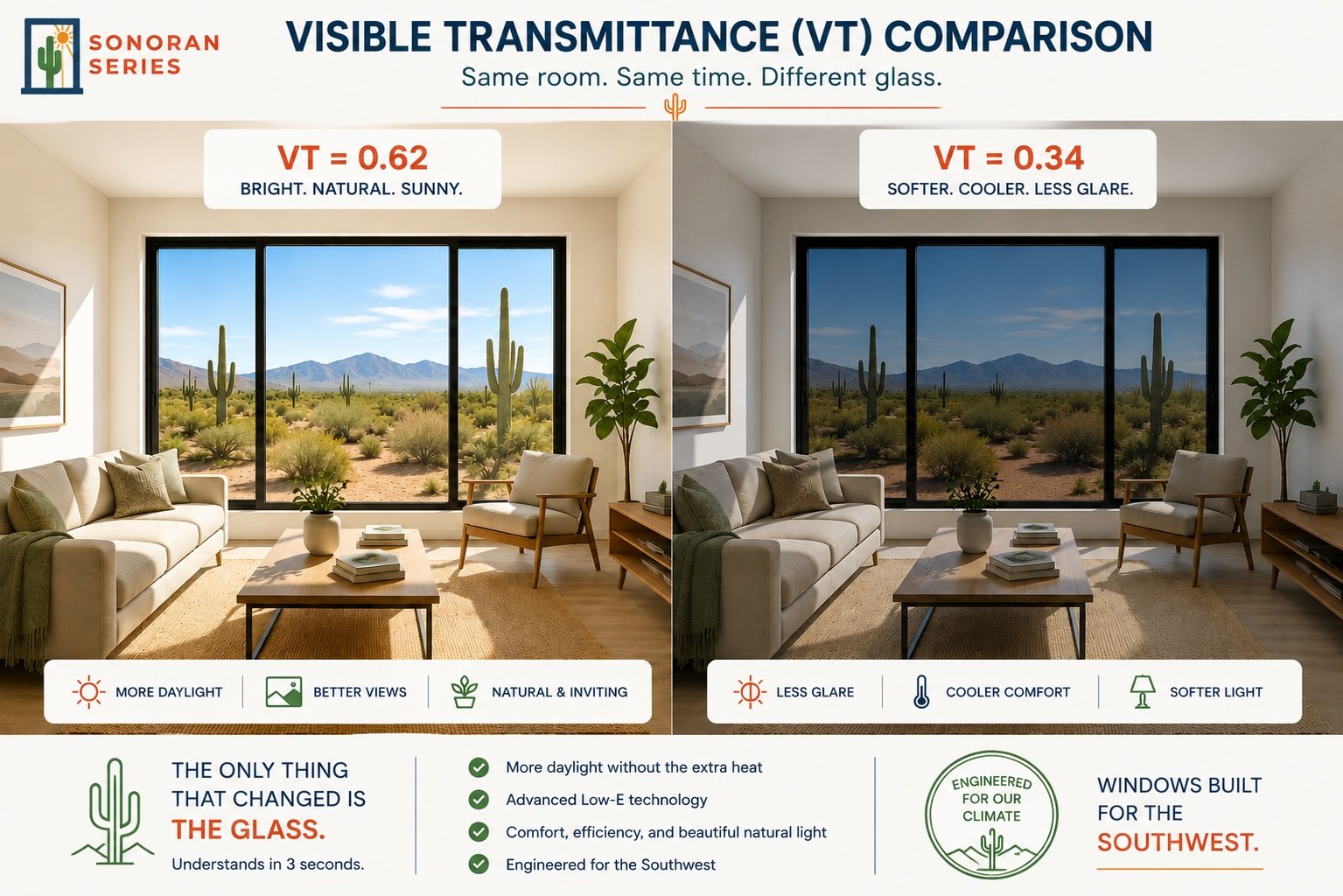
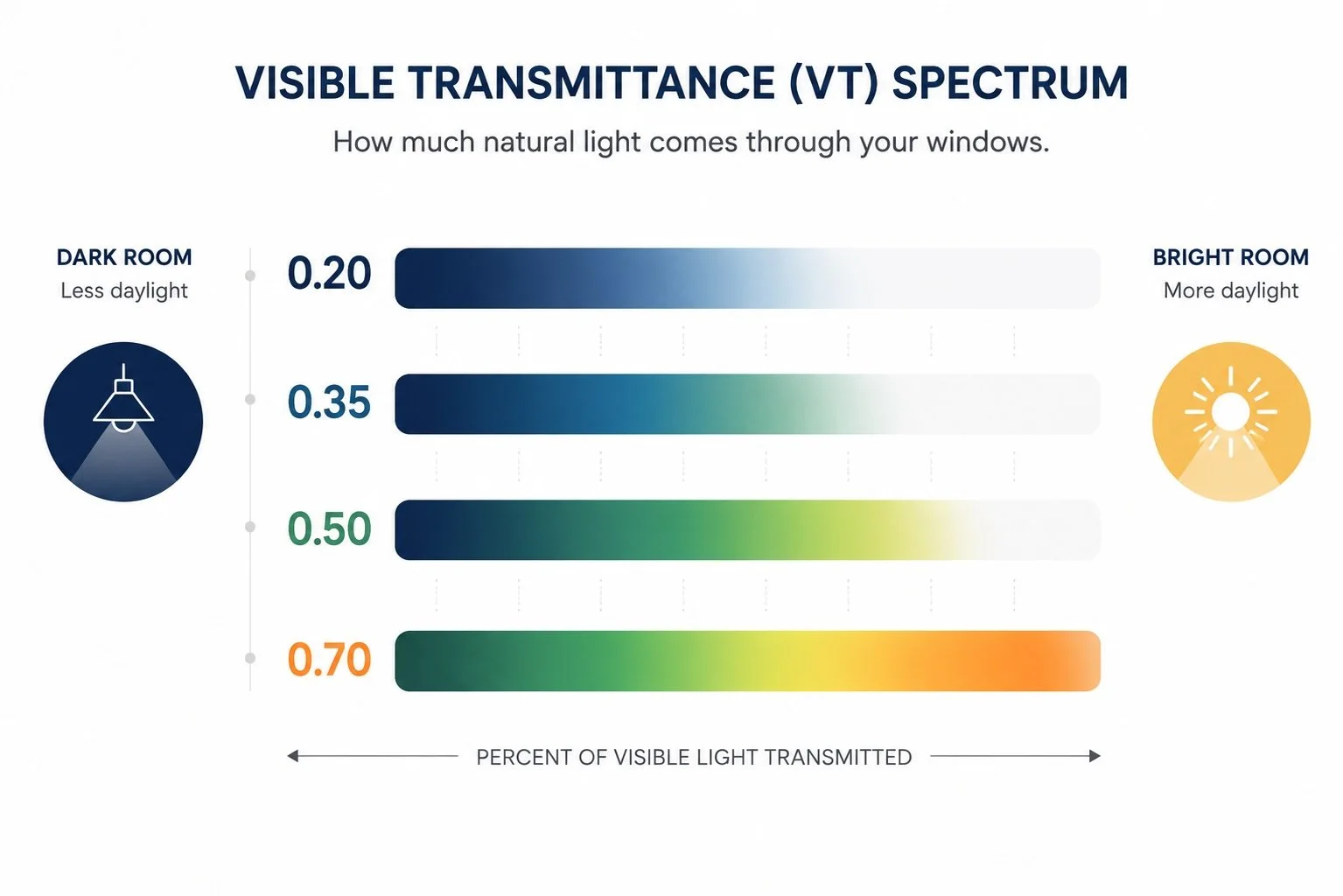
Visible Transmittance (VT) measures the percentage of visible daylight that passes through the complete glazing system.
VT ranges from 0.00 (no visible light) to 1.00 (all visible light).
Most residential Low-E windows fall somewhere between 0.30 and 0.70 depending on the coating and glass package.
Higher VT generally creates:
- Brighter rooms
- Better outdoor views
- More natural daylight
Lower VT generally creates:
- Softer lighting
- Less glare
- Greater privacy in some conditions
🔬 Engineering Insight
Visible Transmittance measures visible light only. It does not measure:
- Heat
- UV radiation
- Infrared energy
That's why two windows can have nearly identical VT values while performing very differently in terms of solar heat rejection.
Modern Low-E coatings are engineered to selectively transmit visible light while reflecting much of the infrared energy responsible for heat.
🌵 Arizona Insight
Arizona homeowners often want two things when it comes to replacing their windows: bright homes and cool homes.
Fortunately, modern glass technology no longer forces you to choose one or the other.
Advanced solar-control coatings can reject a large percentage of solar heat while still allowing plenty of natural daylight into the home. That's one of the biggest advances in window technology over the past few decades.
❌ Common Myth
"Darker-looking glass always blocks more heat."
Not necessarily. Glass tint and solar performance are different characteristics.
Many modern Low-E coatings are nearly invisible while providing excellent solar control. Always compare the actual NFRC ratings—not just the appearance of the glass.
🧠 Remember It Like This
Imagine wearing sunglasses. Some sunglasses are so dark they make everything feel gloomy. Others reduce glare while still letting the world look bright and natural.
Modern Low-E glass works much the same way. The goal isn't simply to make the glass darker—it's to let in the light you want while rejecting the energy you don't.
🎓 Key Takeaways
- VT measures visible daylight entering through the glazing system.
- Higher VT generally means brighter interiors.
- VT is independent of SHGC and U-Factor.
- Modern Low-E coatings can deliver an excellent balance of daylight and solar control.
- The best glass package balances comfort, daylight, efficiency, and the home's orientation.
💡 Pro Tip
Never compare VT by itself. Always compare it alongside SHGC and U-Factor.
Those three numbers together tell a much more complete story about comfort, daylight, and efficiency.
Ready to put this knowledge to work on your own home? Call us today at (480) 665-5732 for a free quote to learn more!